
If you have a website for your business, you probably want people to find it when they search online.
But simply having a website is not enough.
There are millions of websites competing for attention in search engines. When someone searches for a service, product, or answer related to your business, you want your website to appear where potential customers can actually see it.
This is where SEO, or Search Engine Optimization, comes in.
SEO is the process of improving your website and online presence so that search engines can better understand your content and show it to people searching for relevant information, products, or services.
For small businesses, startups, professionals, and organizations, SEO can become one of the most valuable long-term digital marketing strategies.
In this beginner-friendly guide, you’ll learn what SEO is, how it works, why it matters, the main types of SEO, and practical ways to start improving your website.
Key Takeaways
- SEO stands for Search Engine Optimization.
- SEO helps search engines understand and rank your website.
- Good SEO can help your business attract relevant organic traffic.
- SEO involves more than keywords; content, technical performance, user experience, authority, and relevance all matter.
- SEO is a long-term strategy rather than a quick advertising campaign.
- A well-designed website provides the foundation for effective SEO.
What Is SEO?
SEO stands for Search Engine Optimization.
It refers to the strategies and practices used to improve a website’s visibility in search engine results.
For example, imagine you own a web design company in Abuja.
Someone searches:
“web design company in Abuja”
Search engines such as Google need to determine which pages are most relevant and useful for that search.
If your website has strong SEO, search engines may consider your page a relevant result and display it to the searcher.
The goal isn’t simply to get more website visitors.
The goal is to attract the right visitors—people who are actually interested in what your business offers.
How Does SEO Work?
Search engines use complex systems to discover, understand, and rank web pages.
Although search engine algorithms are constantly evolving, the basic process can be understood through three stages:
1. Crawling
Search engines use automated programs, often called crawlers or search engine bots, to discover web pages.
These bots follow links from one page to another and collect information about websites.
For example:
Your homepage may link to:
- About Us
- Services
- Blog
- Contact
- Individual service pages
Search engine crawlers can follow these links and discover the different pages on your website.
2. Indexing
After discovering a page, the search engine processes and stores information about it.
This process is called indexing.
Think of a search engine’s index as a massive digital library.
If your webpage is properly indexed, it can potentially appear in search results when someone searches for information related to it.
3. Ranking
When someone performs a search, the search engine determines which indexed pages are most relevant and useful.
It then ranks those pages in the search results.
This is why two websites covering the same topic may appear in completely different positions.
Why Is SEO Important for Businesses?
SEO can be particularly valuable for businesses that depend on people discovering them online.

Consider the difference between these two situations.
Without SEO
You create a website.
You publish your services.
You wait for visitors.
Very few people discover the website through search.
With SEO
You research what your target audience searches for.
You create useful content around those topics.
You optimize your service pages.
You improve your website’s technical performance.
You build credibility and authority.
Over time, your website can attract people searching for the products, services, and information you provide.
This creates an opportunity to generate organic traffic without paying for every individual visitor.
What Is Organic Traffic?
Organic traffic refers to visitors who reach your website through unpaid search engine results
.
For example, someone searches:
“how much does a website cost in Nigeria?”
They see your article in the search results and click it.
That visitor is organic traffic.
This is different from paid traffic, where a business pays for an advertisement to appear in search results.
Both approaches can be useful.
SEO
You invest in creating and optimizing assets that can generate traffic over time.
Paid advertising
You pay to place your business in front of a targeted audience.
A strong digital marketing strategy can use both.
The Main Types of SEO
SEO is not one single activity.
It consists of several interconnected areas.
1. On-Page SEO
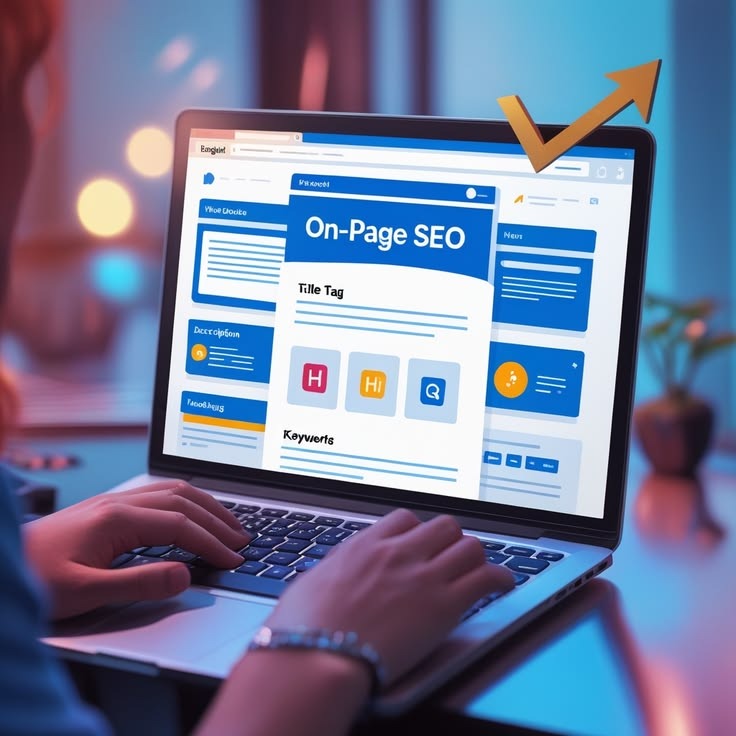
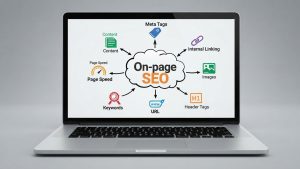
On-page SEO focuses on elements directly on your website.
This can include:
- Page titles
- Headings
- Keywords
- Content quality
- Internal links
- Image optimization
- URLs
- Meta descriptions
- Search intent
- Content structure
For example, if you have a page about WordPress website design, the page should clearly explain the service and use relevant language naturally throughout the content.
The goal is to make the page useful for both users and search engines.
2. Technical SEO

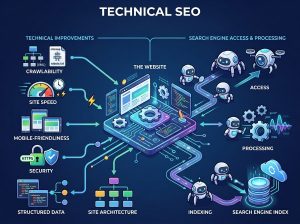
Technical SEO focuses on the technical aspects of your website that affect crawling, indexing, performance, and usability.
Important areas include:
- Website speed
- Mobile responsiveness
- Website security
- XML sitemaps
- Crawlability
- Indexing
- Broken links
- Structured data
- URL structure
- Core Web Vitals
A beautiful website can still struggle in search if its technical foundation is poor.
This is one reason website development and SEO should not be treated as completely separate activities.
3. Off-Page SEO
Off-page SEO focuses on signals and activities that happen outside your website.
One important example is backlinks.
A backlink occurs when another website links to your website.
For example, a Nigerian business publication might publish an article about digital businesses and link to your website as a useful resource.
Quality backlinks can help establish credibility and authority.
However, SEO isn’t simply about collecting as many links as possible.
Quality, relevance, and trust matter.
4. Local SEO
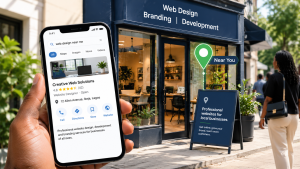
Local SEO focuses on helping businesses appear in searches connected to a specific location.
This is particularly important for businesses that serve customers within a geographical area.
Examples include:
- Restaurants
- Hotels
- Clinics
- Law firms
- Real estate companies
- Training centers
- Event venues
- Professional service businesses
Someone might search:
“website designer in Abuja”
or
“digital marketing agency near me.”
Local SEO helps businesses increase their visibility for searches with local intent.
5. Content SEO
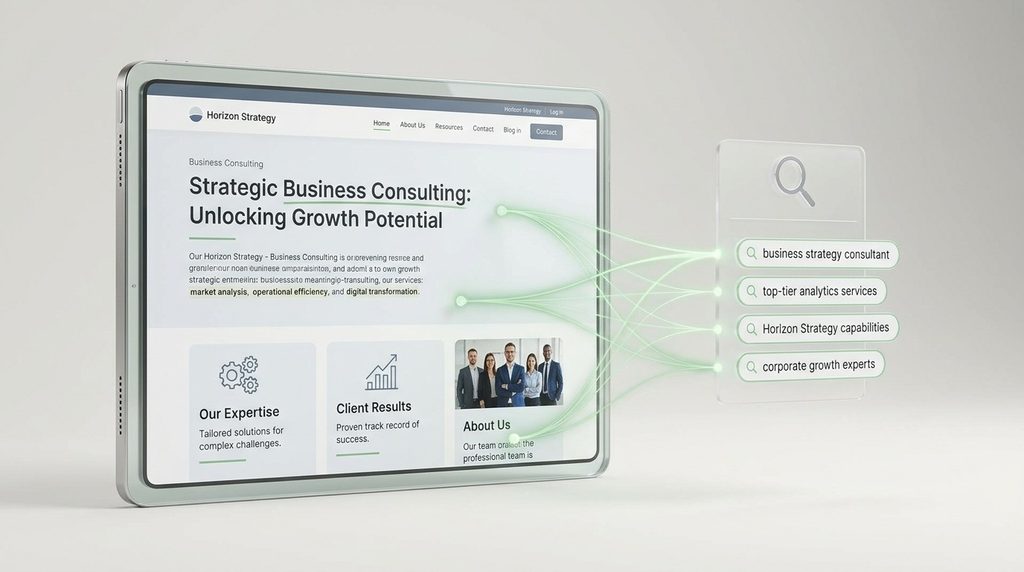
Content plays a major role in modern SEO.
Search engines need information to understand what your website is about and determine whether your pages are useful for particular searches.
Useful content can include:
- Blog articles
- Service pages
- Guides
- Tutorials
- FAQs
- Case studies
- Industry reports
- Resource pages
Instead of creating content simply because you need something to publish, create content around questions and problems your target audience actually cares about.
What Are Keywords in SEO?
A keyword is a word or phrase people enter into search engines.
Examples include:
- website design
- website design company in Abuja
- how to create a business website
- WordPress website development
- social media management
- digital marketing agency Nigeria
These phrases help you understand what your audience is looking for.
However, modern SEO isn’t about repeating a keyword dozens of times.
Search engines have become much better at understanding topics, context, meaning, and search intent.
Your priority should be creating content that genuinely answers the searcher’s question.
What Is Search Intent?
Search intent is the reason behind a search.
Understanding search intent is one of the most important parts of SEO.
For example:
Informational intent
Someone wants to learn something.
“What is SEO?”
Commercial investigation
Someone is researching their options.
“Best website design companies in Nigeria”
Transactional intent
Someone is ready to take action.
“Hire WordPress developer in Abuja”
Navigational intent
Someone is looking for a particular website or brand.
“Penetralia Hub”
If you understand the intent behind a keyword, you can create content that better matches what the searcher actually wants.
SEO vs Paid Advertising: What’s the Difference?
SEO and paid advertising can both bring visitors to your website, but they work differently.
| SEO | Paid Advertising |
| Organic visibility | Paid visibility |
| Usually slower to build | Can generate traffic quickly |
| Long-term potential | Stops when campaigns stop |
| Requires ongoing optimization | Requires ongoing advertising budget |
| Builds content and search visibility | Provides targeted promotional exposure |
Neither approach is automatically better.
The right choice depends on your business, budget, goals, industry, and timeline.
For many businesses, combining SEO with paid advertising can provide both short-term visibility and long-term growth.
How Long Does SEO Take to Work?
One of the biggest misconceptions about SEO is that results should appear immediately.
SEO usually takes time.
You may need to:
- Research your target keywords.
- Improve your website.
- Publish useful content.
- Fix technical issues.
- Build authority.
- Earn relevant backlinks.
- Monitor search performance.
- Update and improve existing content.
The timeline can vary significantly depending on factors such as:
- Your industry
- Competition
- Website authority
- Content quality
- Technical issues
- Search demand
- Location
- Existing online presence
This is why SEO should be treated as a long-term digital growth strategy, not a one-time task.
How to Start SEO for Your Business Website
You don’t need to implement hundreds of SEO tactics on day one.
Start with the fundamentals.
Step 1: Understand Your Audience
Before choosing keywords, understand who you want to reach.
Ask:
- Who are my ideal customers?
- What problems do they have?
- What services are they looking for?
- What questions do they ask?
- What would they search for on Google?
Your SEO strategy should begin with your audience not with a list of random keywords.
Step 2: Research Relevant Keywords
Find the words and phrases your potential customers use when searching for your products or services.
Don’t only target broad keywords.
For example, instead of targeting only:
“web design”
you could target more specific searches such as:
“WordPress website design for small businesses”
or:
“how much does a business website cost in Nigeria?”
Specific searches can help you address more focused needs.
Step 3: Optimize Your Website Structure
Make sure your website is easy for both visitors and search engines to navigate.
Your structure might look like:
Homepage → Services → Individual Service → Contact
and:
Homepage → Blog → Category → Article
Use descriptive URLs, logical navigation, and relevant internal links.
Step 4: Create Helpful Content
Don’t create blog posts simply to fill your website.
Create content that solves real problems.
For example, a web design business could publish articles such as:
- What Is Website Design?
- How Much Does a Website Cost?
- How to Build an Online Presence
- What Is WordPress?
- How Does SEO Work?
- Website Mistakes Small Businesses Should Avoid
Each article can target a specific search intent while supporting the broader authority of the website.
Step 5: Optimize Your Service Pages
Many businesses focus heavily on blogging and neglect their actual service pages.
Your service pages are often some of the most commercially important pages on your website.
A strong service page should clearly communicate:
- What you offer
- Who it is for
- The problem it solves
- Your process
- Benefits
- Relevant evidence or case studies
- Frequently asked questions
- A clear call to action
SEO should ultimately support business goals—not just website traffic.
Step 6: Make Your Website Mobile-Friendly
A large percentage of internet users access websites through mobile devices.
Your website should therefore work properly across different screen sizes.
Check:
- Text readability
- Button sizes
- Navigation
- Page speed
- Forms
- Images
- Spacing
- Overall usability
A website that looks great on a desktop but is frustrating on mobile can lose potential customers.
Step 7: Improve Website Speed
People don’t like waiting for slow websites.
Large images, unnecessary scripts, poor hosting, excessive plugins, and inefficient website configurations can all contribute to slow performance.
Optimizing your website’s performance can improve the experience for visitors and support your overall technical SEO.
Step 8: Track Your Results
SEO should be measurable.
Monitor things such as:
- Organic traffic
- Search impressions
- Search clicks
- Keyword visibility
- Indexed pages
- Click-through rates
- Leads
- Conversions
Don’t judge SEO solely by rankings.
A page ranking #1 for a keyword that generates no business may be less valuable than a page ranking lower for a highly relevant commercial search.
Common SEO Mistakes Businesses Make
Mistake 1: Stuffing Keywords Everywhere
Repeating the same keyword unnaturally can make your content difficult to read.
Write for people first.
Use relevant keywords naturally where they make sense.
Mistake 2: Publishing Low-Quality Content
Publishing dozens of shallow articles isn’t necessarily better than publishing fewer, genuinely useful resources.
Focus on relevance, accuracy, depth, and usefulness.
Mistake 3: Ignoring Technical SEO
A website can have excellent content but still experience search visibility problems because of technical issues.
Your technical foundation matters.
Mistake 4: Focusing Only on Rankings
Rankings are useful indicators, but they aren’t the final objective.
The real goal is to attract relevant visitors and turn them into:
- Customers
- Leads
- Subscribers
- Clients
- Members
- Enquiries
Mistake 5: Expecting Immediate Results
SEO requires patience.
If your website has little authority and you’re competing against established websites, meaningful visibility may take time.
Consistency matters.
Mistake 6: Forgetting About Users
SEO isn’t just about satisfying search engine algorithms.
If visitors arrive at your website and cannot find what they need, they may leave.
Your website needs to satisfy both:
Search engines + real people.
Does Every Business Need SEO?
Not necessarily in the same way.
The importance of SEO depends on how your customers discover businesses in your industry.
For businesses that receive customers through online searches, SEO can be extremely valuable.
For example:
- A local restaurant can benefit from local search visibility.
- A professional service firm can attract people searching for its expertise.
- An e-commerce business can target product searches.
- A training center can attract people searching for courses.
- A technology company can create educational content around industry problems.
The key question isn’t simply:
“Do I need SEO?”
Instead ask:
“Are my potential customers searching online for the problems, products, or services I provide?”
If the answer is yes, SEO deserves serious consideration.
SEO Is Part of a Bigger Digital Strategy
SEO should not exist in isolation.
Your website, branding, content, social media, advertising, and customer experience all contribute to your digital presence.
Think of your digital ecosystem like this:
Brand → Website → Content → SEO → Social Media → Advertising → Leads → Customers
Your website provides the foundation.
Your content gives people reasons to discover and trust you.
SEO helps people find that content.
Social media expands your reach.
Advertising can accelerate visibility.
Your conversion strategy turns attention into business.
When these elements work together, digital marketing becomes much more powerful.
Final Thoughts
SEO is not about trying to trick Google into ranking your website.
It is about making your website relevant, accessible, useful, trustworthy, and easy to understand.
For a business, good SEO begins with understanding your audience and the problems they are trying to solve.
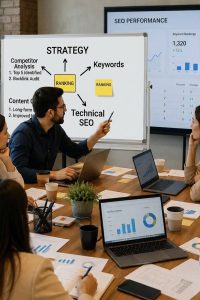
From there, you can create useful content, optimize your website, improve its technical foundation, build authority, and continuously measure your results.
You don’t need to master everything at once.
Start with the fundamentals.
Understand your audience.
Research what they search for.
Build a strong website.
Create genuinely useful content.
Optimize your pages.
Measure what happens.
Then improve over time.
SEO is a long-term investment in your business’s online visibility—and when done properly, it can become one of the strongest foundations for sustainable digital growth.
Frequently Asked Questions About SEO
What does SEO stand for?
SEO stands for Search Engine Optimization. It is the practice of improving a website so search engines can understand and rank its pages for relevant searches.
Is SEO free?
Organic search traffic doesn’t require paying a search engine for every click. However, effective SEO requires investment in strategy, content, website development, technical optimization, tools, and ongoing work.
How long does SEO take?
There is no universal timeline. Results depend on competition, website authority, content quality, technical performance, search demand, and many other factors. SEO generally requires consistent effort over time.
Can I do SEO myself?
Yes. Businesses can handle many basic SEO tasks themselves, particularly keyword research, content creation, page optimization, internal linking, and basic technical improvements. More complex websites may benefit from professional SEO expertise.
Is SEO better than Google Ads?
Neither is universally better. SEO can provide long-term organic visibility, while paid search can provide faster visibility. Many businesses benefit from using both strategically.
Does WordPress work well for SEO?
WordPress can provide a strong foundation for SEO when it is properly configured and supported by good website structure, quality content, technical optimization, performance, and appropriate plugins or tools.
Why isn’t my website showing on Google?
There can be several reasons, including indexing problems, weak or insufficient content, technical SEO issues, lack of authority, high competition, poor targeting, or a new website that has not yet established visibility.
Can social media improve SEO?
Social media can increase content exposure, brand awareness, and opportunities for people to discover and reference your website. While social activity itself should not be treated as a direct replacement for SEO, social media can support a broader digital visibility strategy.
What’s Next?
Understanding SEO is only the beginning.
The next step is learning how to apply SEO to your own website.
Start by reviewing your website’s structure, identifying the searches your target customers are making, and finding pages that could provide better answers to those searches.
If your website is poorly structured, difficult to navigate, slow, or not designed around your customers’ needs, SEO alone won’t solve the problem.
A strong SEO strategy starts with a strong digital foundation.
Build a Website That Can Be Found
SEO works best when it is built into your digital strategy from the beginning not added as an after thought.
At Penetralia Hub, we help businesses establish a stronger digital presence through professional website design, web development, branding, content, digital marketing, and other digital growth solutions.
Whether you’re launching a new business website or improving an existing one, we can help you create a digital foundation that is:
- Designed around your target audience
- Optimized for search engines
- Mobile-friendly and responsive
- Fast and user-focused
- Structured to support your content strategy
- Built to turn visitors into enquiries and customers
Your website shouldn’t just look good. It should help people discover your business, understand what you offer, trust your brand, and take action.
Ready to Build a Stronger Digital Presence?
Let’s create a website and digital strategy that gives your business a stronger foundation for long-term online growth.
Explore Penetralia Hub’s web design and digital growth services today.