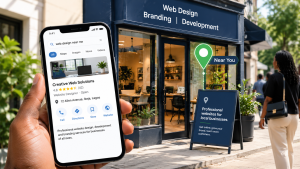
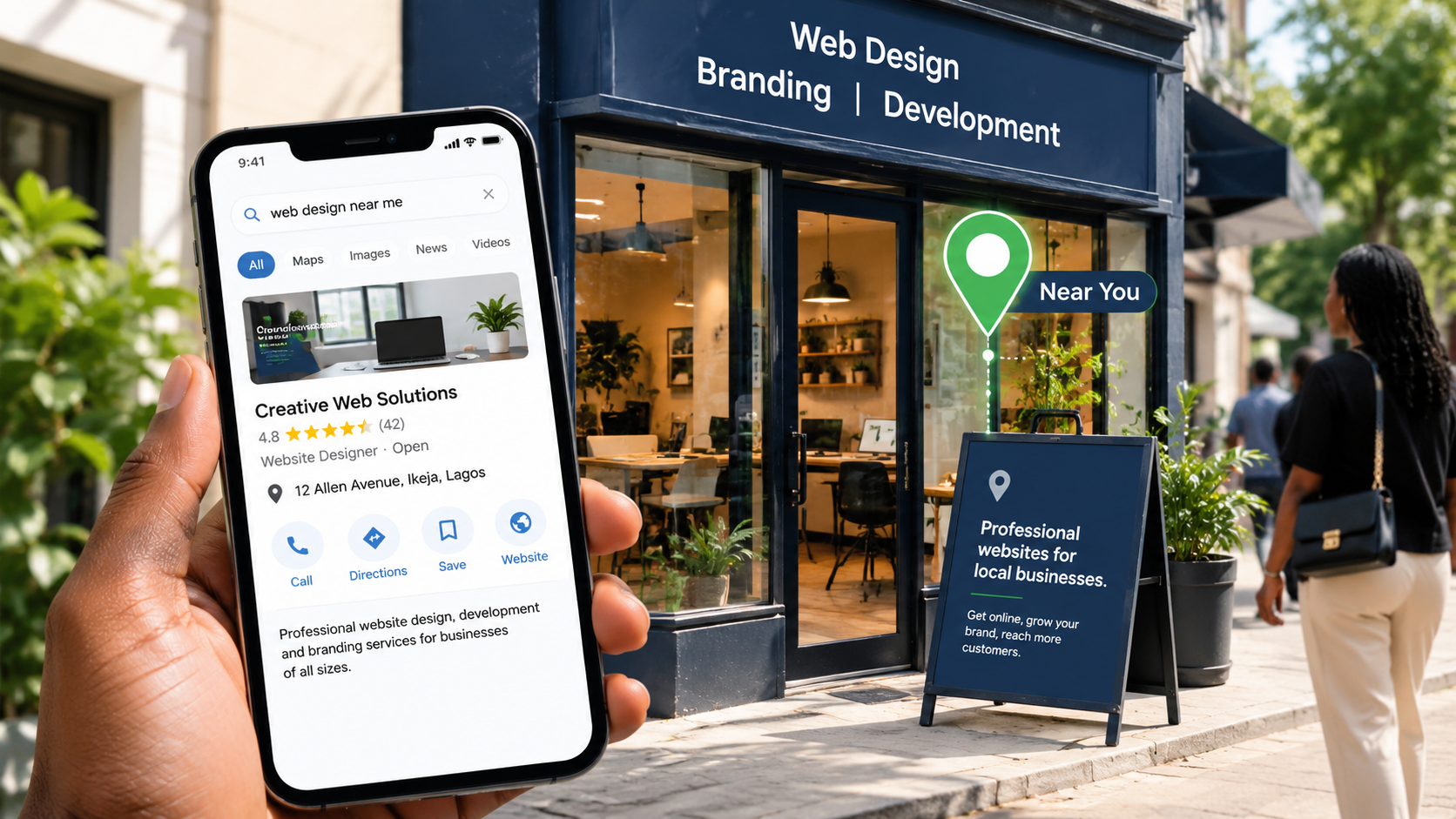
If you run a business that serves customers in a particular city, state, region, or local community, getting found by people nearby can be just as important as appearing in general Google searches.
Imagine someone in Abuja searches:
“web designer near me”
Or someone searches:
“best restaurant in Abuja”
Or:
“cybersecurity company in Nigeria”
These searches are different from broad searches because the person’s location is part of the search need.
This is where local SEO becomes important.
Local SEO is the process of improving your online presence so that your business can become more visible when people search for products, services, or businesses in a specific geographic area.
For a local business, appearing in relevant local searches can help potential customers:
- Discover your business
- Find your location
- Call you
- Visit your website
- Request directions
- Read reviews
- Compare your services
- Contact your business
But local SEO is not simply about adding the name of your city to every page on your website.
It involves your Google Business Profile, website, business information, reviews, local relevance, content, links, and overall online presence.
In this guide, you’ll learn what local SEO is, how it works, why it matters, and how a business can start improving its local search visibility.
Key Takeaways
- Local SEO helps businesses become more visible for relevant searches connected to a specific location.
- It is useful for businesses that serve customers in particular geographic areas.
- Google Business Profile is an important part of local SEO, but local SEO goes beyond your profile.
- Your website should clearly communicate what your business does and where you serve customers.
- Consistent business information across important online platforms can help establish clarity.
- Reviews can influence how potential customers perceive a business and can contribute to local visibility.
- Local content should be useful and genuinely relevant to the location.
- Local SEO is not only about rankings—it can help generate calls, website visits, enquiries, directions, and customers.
What Is Local SEO?
Local SEO is the process of optimizing your business’s online presence to improve visibility in search results connected to a specific geographic location.
For example, a web development company serving Abuja may want to appear when people search for:
- web development company in Abuja
- website designer in Abuja
- WordPress developer in Abuja
- web design services near me
A restaurant may target searches such as:
- restaurants in Abuja
- restaurants near me
- best Nigerian restaurant in Abuja
A law firm may want visibility for:
- lawyers in Abuja
- law firm in Abuja
- corporate lawyer in Abuja
The common factor is local relevance.
The searcher isn’t simply looking for information.
They are looking for something associated with a particular place.
How Is Local SEO Different From Regular SEO?
Traditional SEO and local SEO share many principles, but the focus is different.
Traditional SEO
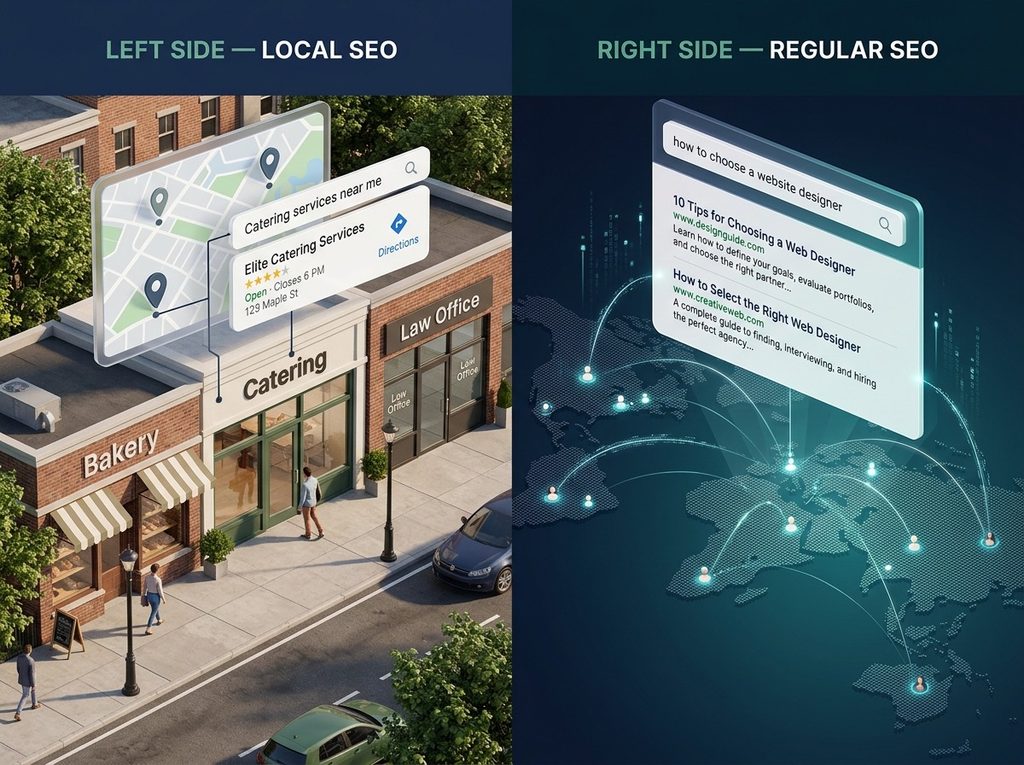
Traditional SEO generally focuses on helping a website appear for relevant searches regardless of where the searcher is located.
For example:
what is website design?
Anyone anywhere could search this.
Local SEO
Local SEO focuses on searches where location or local intent matters.
For example:
website designer in Abuja
The searcher’s location is part of the requirement.
A useful way to think about it is:
SEO:
“Can people searching for this topic find my website?”
Local SEO:
“Can people searching for this service or business in my area find me?”
For businesses that depend on local customers, both can be important.
What Businesses Need Local SEO?
Local SEO is particularly useful for businesses that serve customers in specific geographic areas.
Examples include:
- Restaurants
- Hotels
- Hospitals and clinics
- Schools and training centers
- Law firms
- Real estate companies
- Construction companies
- Event venues
- Beauty businesses
- Professional services
- Retail stores
- Consultants
- Local agencies
- Repair services
- Fitness centers
- Hospitality businesses
It can also benefit businesses that operate across several cities or regions.
For example, a company might serve:
- Abuja
- Lagos
- Port Harcourt
- Ibadan
In that situation, its local search strategy may need to communicate its service areas clearly without creating low-quality duplicate pages for every possible location.
What Is Local Search Intent?
Not every search containing a location is necessarily local in the same way.
Consider:
“history of Abuja”
and:
“website designer in Abuja”
The first is primarily informational.
The second has strong local commercial intent.
Other signals can include phrases such as:
- near me
- in Abuja
- in Lagos
- nearby
- local
- open now
- best
- services
- company
- agency
- shop
- restaurant
Search engines use various signals to determine whether a query has local intent and which local results may be relevant.
Understanding this intent is important because it helps you create the right type of content and business information.
Google Business Profile and Local SEO
One of the most important tools for many local businesses is a Google Business Profile.
A Business Profile allows eligible businesses to manage information that can appear in Google’s local search experiences.
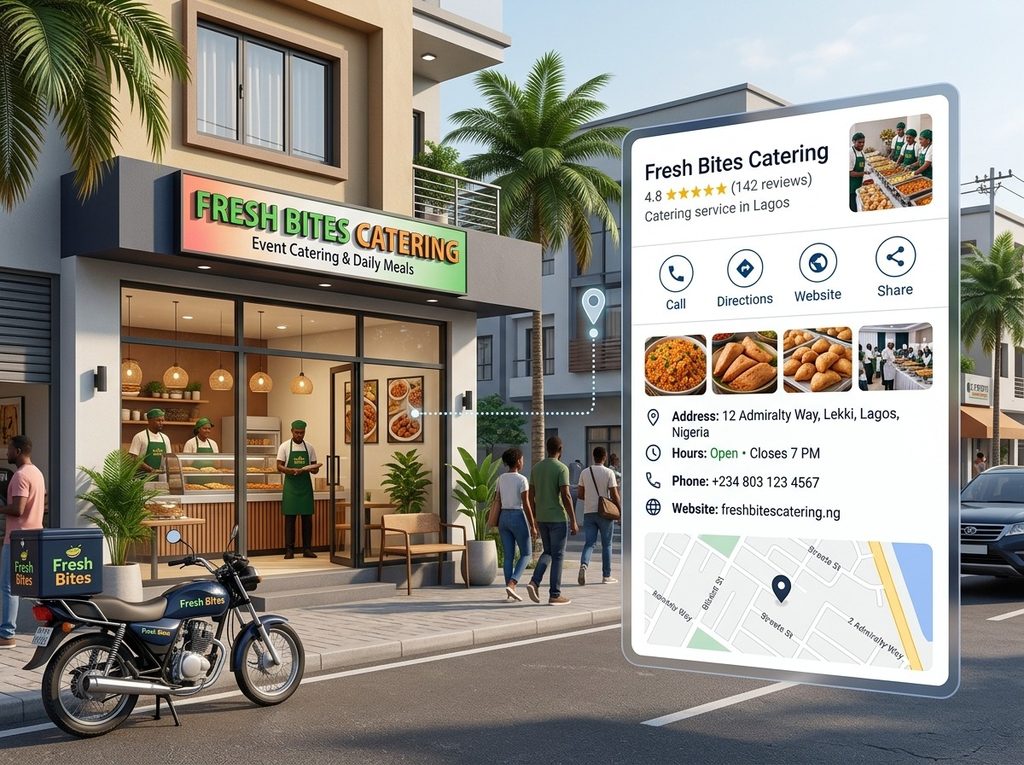
Depending on the business and context, customers may see information such as:
- Business name
- Category
- Address or service area
- Phone number
- Website
- Opening hours
- Photos
- Reviews
- Services
- Other business details
For someone searching for a local business, this information can make the difference between simply seeing a business name and having enough information to contact or visit that business.
However, your Google Business Profile should not be treated as a replacement for your website.
Your website and Business Profile should work together.
Your Google Business Profile Should Be Complete and Accurate
If you have a Business Profile, review the information carefully.
Check:
- Business name
- Primary category
- Additional relevant categories
- Address
- Service areas where applicable
- Phone number
- Website
- Opening hours
- Business description
- Services
- Photos
Keep the information accurate.
If your business changes its phone number, operating hours, address, or other important information, update your online presence accordingly.
Incorrect information can create confusion for potential customers.
Choose the Right Business Category
Your business category helps communicate what your business does.
For example, a restaurant should not choose a category simply because it sounds popular.
A web development company should select a category that accurately represents its business.
Your category should reflect your actual primary business activity.
You may also have opportunities to add relevant secondary categories where appropriate.
Don’t select unrelated categories simply because you think they might attract more searches.
Accuracy is more important than trying to manipulate the system.
Your Website Still Matters
One of the biggest misconceptions about local SEO is:
“If I have a Google Business Profile, I don’t need a website.”
For many businesses, that’s a missed opportunity.
Your website provides space to explain your business in much greater detail.
It can contain:
- Service pages
- Product information
- About page
- Contact information
- Location information
- FAQs
- Customer resources
- Case studies
- Blog articles
- Booking or enquiry forms
Your Business Profile can help people discover you.
Your website can help them understand, trust, and choose your business.
Create Location-Relevant Website Content
Your website should clearly communicate where your business operates when location is relevant to your service.
For example:
Penetralia Hub provides website design, web development, and digital consultancy for businesses and organizations.
If your service area is relevant, you can make it clear:
We provide website design and development services for businesses in Abuja and across Nigeria.
This is much more useful than repeatedly inserting:
website design Abuja website design Abuja website design Abuja
throughout the page.
Don’t keyword-stuff location names.
Write naturally.
Create Strong Local Service Pages
If you serve a particular location, your service pages should clearly explain:
- What you offer
- Who you serve
- Where you operate
- What makes your service useful
- How customers can contact you
For example, instead of creating a generic page called:
Services
you may have individual pages such as:
Website Design
Web Development
SEO Services
Social Media Management
Each page can explain the service in detail and naturally mention relevant service areas where appropriate.
This provides much stronger context than simply adding a city name to a title.
Be Careful With Location Pages
Businesses sometimes create dozens of pages such as:
- Website Design Abuja
- Website Design Lagos
- Website Design Ibadan
- Website Design Kano
- Website Design Port Harcourt
- Website Design Enugu
But if every page contains essentially the same content with only the city name changed, those pages may provide little additional value.
A location page should exist because it serves a genuine purpose.
A useful location page could include:
- Services available in that location
- Relevant local information
- Local customer needs
- Areas served
- Local projects or examples where appropriate
- Contact information
- Genuine local experience
Don’t create pages simply to occupy more search results.
Keep Your Business Information Consistent
Your business information should be accurate across important online platforms.
Pay particular attention to:
Name
Address
Phone number
This information is often referred to as NAP information.
If your business appears as:
Penetralia Hub
on one platform,
but:
Penetralia Hub Digital Solutions Ltd
on another,
that difference may create unnecessary confusion depending on the context.
Consistency helps people—and search engines—understand which business they’re looking at.
The goal is not to obsess over tiny formatting differences.
The goal is to maintain clear, accurate business information.
Reviews Matter
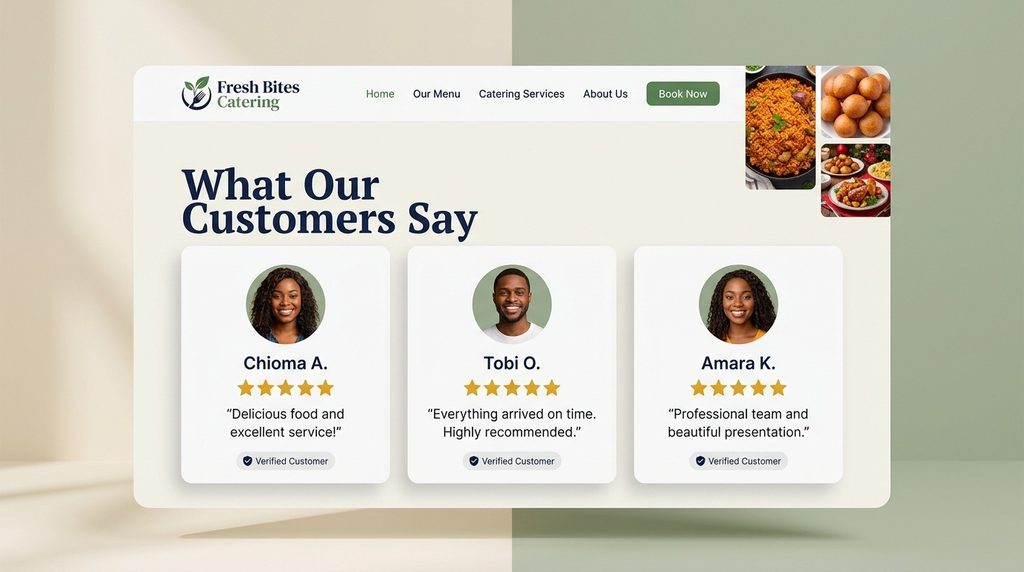
Reviews are an important part of local business visibility and customer decision-making.
Think about your own behavior.
If you search for:
“best restaurant near me”
and see two similar businesses, one with many recent positive reviews and another with very few reviews, the reviews may influence which one you investigate.
Reviews can therefore support both:
- local reputation
- customer decision-making
Encourage genuine customers to leave honest reviews after using your service.
Don’t Buy or Manufacture Reviews
Fake reviews may create short-term numbers but can damage trust and potentially violate platform policies.
Instead:
- Deliver a good experience.
- Ask customers for honest feedback.
- Make the review process easy.
- Respond professionally.
- Learn from recurring complaints.
Respond to Reviews Professionally
Your response to a review can also communicate something about your business.
For positive reviews:
Thank the customer genuinely.
For negative reviews:
Remain professional and avoid arguing publicly.
Where appropriate, acknowledge the concern and invite the customer to continue the conversation privately.
Your review section is not only for the person who left the review.
Potential customers may read your responses before deciding whether to contact you.
Build Local Content Around Customer Needs
Local SEO and content marketing can work together.
Suppose you run a training center in Abuja.
Instead of publishing only:
Our Training Services
you could create useful content such as:
- How to Choose the Right Digital Skills Training Program
- Digital Skills Businesses Need in 2026
- How Small Businesses Can Train Their Teams in Digital Marketing
- What to Look for in a Professional Training Center
Where genuinely relevant, you can incorporate information about your local audience.
The goal is not to mention your city in every paragraph.
The goal is to create useful content for the people you actually serve.
Use Location-Based Keywords Naturally
Location keywords can help when they accurately describe your service.
Examples:
- web design in Abuja
- branding agency in Lagos
- training center in Abuja
- podcast studio in Abuja
- digital marketing services in Nigeria
But don’t force them into every sentence.
A natural sentence might be:
We provide website design and development services for businesses in Abuja and clients across Nigeria.
That’s better than repeating:
Abuja website design company Abuja website designer Abuja website development.
Good local SEO should sound like normal communication.
Optimize Your Contact Page
Your Contact page is particularly important for a local business.
Make it easy for people to find:
- Business name
- Phone number
- Email address
- Physical address where applicable
- Business hours
- Service area
- Directions or map information where appropriate
- Contact form
- Relevant social profiles
Don’t make potential customers search through five pages just to find your phone number.
Add Your Location Where It Helps Users
If you have a physical location that customers visit, make the location easy to understand.
For example:
Visit our office in Abuja.
Then provide useful information such as:
- address
- nearby landmarks
- operating hours
- parking information where relevant
- directions
The objective is not to add location information purely for SEO.
It is to make it easier for customers to find you.
Build Local Links and Mentions
Links from other relevant websites can contribute to your broader SEO strategy.
For local businesses, relevant local mentions can be useful.
Examples might include:
- local business directories
- industry organizations
- professional associations
- local publications
- community organizations
- event websites
- partner organizations
The emphasis should be on relevance and legitimacy.
Don’t purchase hundreds of low-quality directory links simply because someone promises fast rankings.
A small number of relevant, trustworthy mentions can be more useful than a large number of meaningless links.
Use Local Business Structured Data Where Appropriate
Structured data can help communicate information about your organization to search engines.
For eligible businesses, relevant structured data may communicate details such as:
- business type
- name
- address
- contact information
- website
- other supported information
This should be implemented accurately.
Don’t add information to structured data that isn’t actually represented on the page or doesn’t accurately describe the business.
Technical implementation may require a developer.
Local SEO for Service-Area Businesses
Not every local business has a storefront.
Some businesses travel to customers or provide services remotely within defined areas.
Examples include:
- plumbers
- electricians
- consultants
- photographers
- event services
- construction companies
- home services
These businesses can still benefit from local SEO.
Their strategy may focus on clearly communicating:
- areas served
- services offered
- contact information
- service availability
- relevant local content
The important distinction is between where the business operates and where customers can physically visit the business.
Local SEO for Businesses With Multiple Locations
Businesses with multiple genuine locations need a more structured approach.
For example, a company might have offices in:
- Abuja
- Lagos
- Port Harcourt
Each genuine location may require its own accurate business information.
The website can also provide useful location-specific pages when appropriate.
Each location page should provide meaningful information rather than simply duplicating the same content.
Local SEO for Businesses in Nigeria
Local SEO can be particularly useful in Nigeria because customers frequently use search engines to find:
- businesses
- restaurants
- professionals
- services
- offices
- stores
- schools
- hotels
- event venues
For Nigerian businesses, local visibility can involve location terms such as:
- Abuja
- Lagos
- Ibadan
- Port Harcourt
- Kano
- Enugu
- Kaduna
- Benin City
But businesses should focus on the locations they actually serve.
Don’t claim locations simply because you want to rank there.
If you operate in Abuja but serve customers nationwide, communicate that clearly.
How to Improve Local SEO Step by Step
If you’re starting from scratch, follow this process.
Step 1: Define Your Service Area
Write down:
- Where is your business located?
- Where do you serve customers?
- Do customers visit your location?
- Do you travel to customers?
- Do you operate nationwide?
This determines your local strategy.
Step 2: Create or Claim Your Google Business Profile
If your business is eligible, create or claim the appropriate Business Profile.
Complete the information accurately.
Step 3: Choose the Correct Categories
Select categories that genuinely represent your business.
Step 4: Complete Your Business Information
Add accurate:
- phone
- website
- hours
- address or service-area information
- services
- business description
Step 5: Improve Your Website
Make sure your website clearly explains:
- what you do
- who you serve
- where you operate
- how people can contact you
Step 6: Create Strong Service Pages
Don’t put all your services on one vague page.
Where appropriate, create dedicated pages that explain each major service.
Step 7: Add Useful Local Content
Create articles and resources that answer questions your local customers actually ask.
Step 8: Encourage Genuine Reviews
Ask satisfied customers for honest feedback.
Don’t manufacture reviews.
Step 9: Build Relevant Local Visibility
Look for legitimate opportunities to be mentioned by:
- associations
- local publications
- industry organizations
- partners
- community organizations
Step 10: Monitor Your Results
Track:
- calls
- enquiries
- website traffic
- search queries
- profile interactions
- directions where applicable
- leads
- customer acquisition
Don’t measure local SEO success only by rankings.
What Should You Track?
Local SEO success can involve several metrics.
Search Visibility
Are you appearing for relevant local searches?
Website Traffic
Are people arriving from search?
Phone Calls
Are potential customers contacting you?
Form Submissions
Are visitors sending enquiries?
Directions
For physical businesses, are people requesting directions?
Profile Interactions
Are people engaging with your business information?
Leads and Customers
Most importantly:
Is local search contributing to business?
This is the metric that ultimately matters most.
Common Local SEO Mistakes
1. Creating a Google Business Profile and Stopping There
Your Business Profile is important, but it is only one part of local SEO.
Your website and wider online presence still matter.
2. Using the Wrong Business Category
Choose a category that accurately represents your business.
3. Keyword Stuffing Your Business Name
Don’t manipulate your business name by adding unnecessary keywords.
Use your real business name.
4. Creating Fake Locations
Don’t claim an office or service location that doesn’t genuinely exist.
5. Creating Duplicate City Pages
Changing only the city name on dozens of identical pages doesn’t create meaningful local content.
6. Ignoring Reviews
Reviews can influence both reputation and customer decisions.
7. Having Inconsistent Business Information
Make sure important business information is accurate and maintained.
8. Forgetting Your Website
A Business Profile can help people discover you, but your website often provides the deeper information they need before making a decision.
9. Focusing Only on Rankings
Ranking number one is useful, but local SEO should ultimately support real business outcomes.
How Long Does Local SEO Take?
There is no universal timeline.
Results can depend on:
- competition
- location
- industry
- website quality
- business reputation
- existing authority
- content
- technical SEO
- review profile
- local competition
- consistency of optimization
A new business in a competitive city may need more time than an established business with strong local recognition.
Avoid agencies that promise guaranteed number-one rankings within a few days.
A sustainable local SEO strategy focuses on building a trustworthy and useful online presence over time.
Local SEO and Your Overall Digital Strategy
Local SEO shouldn’t exist in isolation.
Consider how these areas connect:
Website Design
Creates a professional digital home for your business.
↓
Keyword Research
Identifies what potential customers are searching for.
↓
On-Page SEO
Makes individual pages relevant and useful.
↓
Technical SEO
Provides a strong technical foundation.
↓
Local SEO
Connects your business to location-specific searches.
↓
Content
Answers customer questions and builds topical relevance.
↓
Conversion Optimization
Turns relevant visitors into enquiries and customers.
This is why your website should be planned with both users and search visibility in mind from the beginning.
Build a Strong Local Online Presence With Penetralia Hub
If your business depends on customers finding you online, local visibility should be part of your digital strategy—not an afterthought.
At Penetralia Hub, we help businesses build professional digital foundations that support visibility, credibility, and growth.
Our Website Design, Web Development, and Consultancy services can help you develop a website that clearly communicates:
- what your business does
- who you serve
- where you operate
- what makes your business different
- how customers can contact you
We can also help structure your website around:
- local search opportunities
- service-specific pages
- clear navigation
- SEO-friendly content structure
- mobile responsiveness
- strong calls to action
- conversion-focused layouts
Whether you are launching a new business, redesigning an existing website, or trying to improve your local search presence, the objective is the same:
Make it easier for the right people to discover your business, understand what you offer, trust your brand, and take action.
Your local customers are already searching.
The question is:
Can they find you when they do?
Frequently Asked Questions
What is local SEO in simple terms?
Local SEO is the process of improving a business’s online presence so it can become more visible when people search for relevant businesses, products, or services in a particular location.
Is local SEO only for businesses with physical stores?
No. Service-area businesses can also benefit from local SEO. The strategy can be adapted based on where the business operates and whether customers visit a physical location.
Do I need a website for local SEO?
A business may benefit from local search visibility without a sophisticated website, but a strong website gives you much more control over your services, content, credibility, and customer journey.
Is Google Business Profile the same as local SEO?
No. Google Business Profile is an important component of local SEO, but local SEO also involves your website, reviews, business information, local content, links, technical SEO, and other online signals.
How do I improve my local SEO?
Start by accurately setting up your Google Business Profile, optimizing your website, creating useful service and location-relevant content, maintaining consistent business information, earning genuine reviews, and building relevant local visibility.
How important are reviews for local SEO?
Reviews are important for local reputation and can influence how potential customers evaluate a business. Genuine reviews also form part of the broader information associated with a local business.
Should I put my city name on every page?
No. Mention your location where it is genuinely relevant and useful. Repeating a city name unnecessarily can make content unnatural and does not create a better user experience.
How do I rank for “near me” searches?
You cannot simply add “near me” repeatedly to your website. Instead, build a strong local presence, maintain accurate business information, provide relevant services, optimize your website, and establish genuine local relevance.
Can local SEO work for a business serving customers across Nigeria?
Yes. A business can have a broad service area while still communicating its base location and the areas it genuinely serves. The website and business information should accurately reflect the actual operation.
How long does it take to see local SEO results?
It varies considerably. Competition, location, industry, website quality, existing authority, reviews, and other factors can influence how quickly visibility improves.
Final Thoughts
Local SEO is ultimately about being visible where your customers are looking.
If someone searches for a service in your area, you want your business to have a legitimate opportunity to appear.
But local SEO is bigger than adding your city to a webpage.
It involves building a consistent and trustworthy digital presence through:
- an accurate Google Business Profile
- a professional website
- clear service pages
- useful local content
- genuine customer reviews
- accurate business information
- relevant local visibility
- strong technical foundations
- a clear path for customers to contact you
Don’t think of local SEO as a trick for manipulating Google.
Think of it as making your business easier to discover, understand, trust, and contact.
When those pieces work together, local search can become an important source of qualified visitors, enquiries, and customers.
And for a business that depends on its local market, that visibility can become a genuine competitive advantage.